Enterprise Payments Platform
Payment Platform Transformation
Unifying a fragmented enterprise payments ecosystem — while maturing the design function that owned it.
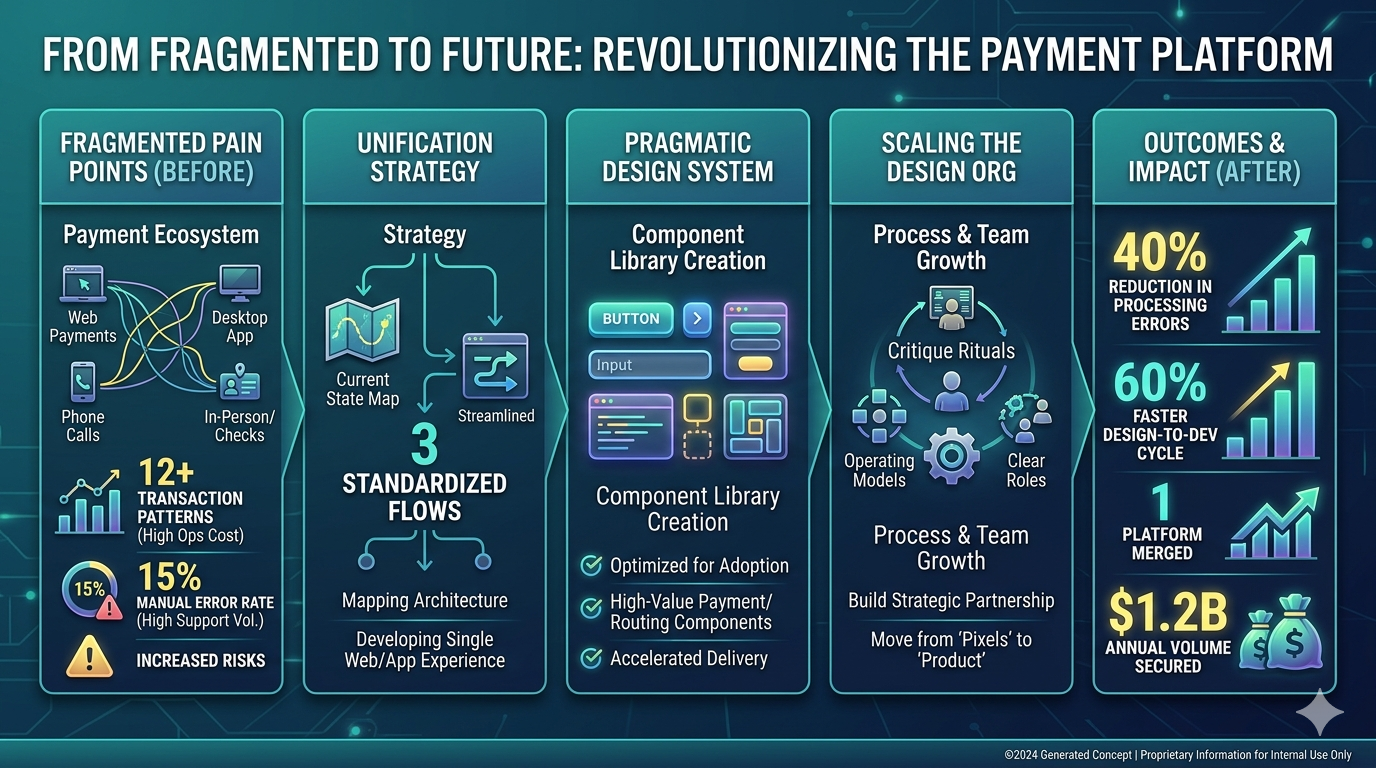
At a glance
Context
The enterprise payment routing system, handling over $1.2B annually, had grown through rapid acquisitions and feature additions. The platform — RentCafe — had drifted into inconsistent experiences across web surfaces with no unified mobile experience, a ~15% error rate in manual transaction processing, and a high volume of support tickets.
Aside from the operational drag, customer behavior said it all: paying rent was so cumbersome that residents chose to pay in person, by check, in an era where every other financial interaction had gone mobile-first.
The mandate wasn't 'redesign payments.' It was 'get design to a place where it can lead here.' That framing changed everything downstream.
Constraints
- 01
Fragmented payments ecosystem — no shared components, no shared vocabulary, no shared owner. 12 disparate transaction patterns across acquired products.
- 02
Engineering velocity was high and could not be paused for a rebuild. Any system had to ship incrementally inside live releases.
- 03
Design team of two, hiring headcount not yet approved. Case for scale had to be made before scale was allowed.
- 04
Cross-functional stakeholders — product, engineering, compliance, ops — who had never worked with a design leader with a seat at the table.
Approach
Framed design as an operating problem, not a craft problem
The first six months were mostly not about pixels. I mapped how design decisions were made, by whom, and where they got stuck. That became the case for hiring, for the system, and for the operating model — in that order.
Unified 12 patterns into 3 — inside live releases
Partnered with engineering and product leadership to map the existing architecture and define the future state of the unified platform. We collapsed 12 disparate transaction patterns down to 3 standardized flows without disrupting the $1.2B annual transaction volume.
Built the design system as a byproduct of shipped features
Rather than pitching a system-first initiative, I structured each roadmap feature to produce reusable primitives. Financial data display, transaction routing, and edge-case error states got solved once — then reused. Adoption happened before there was ever a formal launch.
Scaled the team against real, defensible demand
Every hire was tied to a business surface with an owner, a scorecard, and a stakeholder who had already asked for design partnership. Grew from 2 to 12 without a single role I couldn't defend to the CFO.
“A passionate, experienced UX practitioner. Her design-thinking and collaboration skills were invaluable. Her professionalism and approach made it a pleasure to work with her.”
Artifacts
Outcome
The new resident portal processed $250M+ in the first six months post-launch, on track for $1B+ annually. Billing escalations dropped by roughly 25%, and manual processing errors fell by 40%.
Design-to-dev cycle time dropped ~60% after adoption of the shared component library. Three legacy tools were successfully merged into a single platform without disrupting the $1.2B annual transaction volume.
The team grew from two designers to twelve, structured around business lines rather than platform silos. Design earned a permanent seat in roadmap review, business reviews, and org planning.
Most importantly: 'design at this company' meant something different by the end. Not a service. A function.
What I'd do differently
I'd invest in a formal system launch earlier. Shipping the system as a byproduct got us there quietly, but a real 1.0 moment — with a name, a versioning story, and internal comms — would have compounded adoption a quarter or two faster. The org was ready for it before I was.
§ End of case 02